

 By
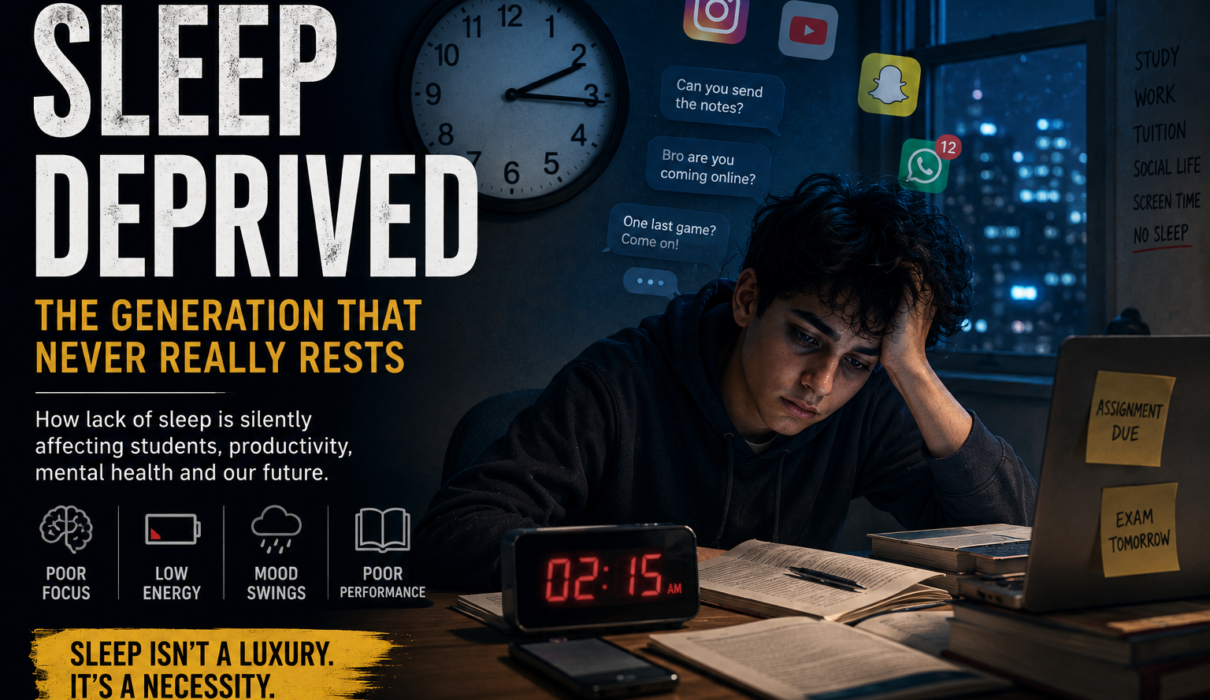
By Sleep is one of the most basic biological needs, yet millions of people are treating it as something they can postpone. We work late, study late, scroll late, wake up early and then wonder why we are exhausted. The modern world has created a strange contradiction: we have never had more technology designed to make life easier, yet so many people have never been more sleep-deprived.
Sleep has gradually moved from being a natural part of daily life to something people try to “fit in” between responsibilities.
For students, it may be exams and assignments. For professionals, deadlines and long working hours. For parents, family responsibilities. For everyone, there is one more notification, one more episode, one more video and one more email. The result is a society that is increasingly awake but not necessarily functioning at its best.
The Most Valuable Thing We Keep Giving Away
Modern society celebrates being busy. A person who works late is considered dedicated. A student studying until 2 a.m. is considered hardworking. Someone answering emails at midnight appears committed. Someone who wakes up at 5 a.m. is considered disciplined. But very rarely do we celebrate someone for simply getting enough sleep.
Sleep has become strangely associated with laziness.
“I only slept four hours last night.”
The sentence is sometimes delivered almost as a badge of honour. There is an unspoken belief that the less we sleep, the more seriously we are taking our responsibilities.
Yet sleep is not wasted time. It is a fundamental biological process that supports memory, learning, emotional regulation, immune function and physical health. The human body does not stop working when we sleep.
It changes what kind of work it is doing.
The Smartphone Beside the Pillow
For many people, the final thing they see before sleeping is a screen And the first thing they see after waking is also a screen.
The phone has become an alarm clock, newspaper, entertainment centre, workplace, classroom and social environment in one small device. That creates a problem that previous generations did not experience in the same way. The bedroom is no longer necessarily associated with sleep.
It can be a place for: work, entertainment, communication, shopping, gaming and news.
A person may physically be in bed while mentally being somewhere else entirely.
Modern sleep deprivation isn’t always caused by dramatic decisions.
Students: When Sleep Becomes the First Thing Sacrificed
For students, the pressure can be particularly intense.
School and college are followed by assignments, tuition, coaching classes, entrance examinations, projects and revision. Competitive exams can create an environment where every hour appears valuable.
A student may think: “If I sleep for eight hours, that’s eight hours I could have used to study.”
But sleep itself is closely connected with learning and memory.The brain uses sleep to consolidate information and support cognitive functioning.
This creates a cruel paradox: Students may sacrifice sleep to perform better academically, while insufficient sleep can make concentration, memory and learning more difficult.
The extra hours may not always produce the extra performance students expect.
The Workplace That Travels Home
Adults face a different version of the same problem. The traditional working day may officially end at 6 p.m. But the smartphone has made it possible for work to continue indefinitely.
A message from a manager.
An urgent email.
A presentation for tomorrow.
A meeting scheduled across time zones.
A notification that appears at 10:47 p.m.
The physical workplace may have disappeared from view.
The psychological workplace hasn’t.
People can lie in bed while thinking about tomorrow’s meeting. They can be exhausted but unable to switch off. The body may be ready for sleep while the mind remains at work.
The Rise of the “Always Available” Human
Technology has created an expectation of constant availability. If someone doesn’t respond quickly, people may wonder why. If an employee doesn’t answer at night, they may worry about appearing uncommitted. If a friend doesn’t reply, someone may assume they are ignoring them. Being offline has become unusual. And that has created a new kind of pressure:
the pressure to remain reachable.
Sleep requires temporary disconnection. Modern life increasingly demands permanent connection. Those two things do not naturally fit together.
Teenagers Are Caught in the Middle
Teenagers face perhaps one of the most complicated sleep situations. Adolescence naturally shifts the body’s internal clock later, meaning many teenagers don’t become sleepy as early as younger children. Yet school schedules often require them to wake early. Add homework, coaching, examinations, social media, gaming and conversations with friends, and the available sleeping hours become even smaller.
The result can be a teenager who is expected to: wake early, concentrate for hours, study after school, perform academically, maintain friendships, exercise, participate in activities and still sleep enough.
The Paradox of Technology
Technology was supposed to make life easier. Automation was supposed to save time. Smartphones were supposed to improve communication. The internet was supposed to make information accessible. Streaming was supposed to make entertainment convenient. Yet many people now feel as though they have less time than ever.
Why?
Because technology didn’t simply make existing activities faster. It created more activities. If an email takes 30 seconds to answer, we don’t save the remaining time.
We answer more emails.
If entertainment becomes instantly available, we don’t necessarily watch less.
We watch more.
If communication becomes easier, we don’t necessarily communicate less.
We communicate constantly.
Technology has expanded the day without expanding the number of hours available to live it.
Sleep Is Not a Productivity Hack
There is a growing tendency to discuss sleep as another tool for becoming more productive.
Sleep improves performance.
Sleep improves concentration.
Sleep helps memory.
Sleep makes you more efficient.
All of that may be true.
But reducing sleep to another productivity strategy misses the larger point. Human beings need sleep whether or not it makes them more productive. A person doesn’t need to justify eight hours of sleep by explaining how much work they will accomplish tomorrow. Sleep is a biological necessity. It is not a reward for finishing your work.
The Hidden Cost of a Sleep-Deprived Society
The consequences extend beyond individual tiredness. A population that regularly sleeps too little can face wider problems involving: healthcare, workplace productivity, road safety, education and mental wellbeing.
Fatigue can affect reaction time and attention, which matters in driving and safety-sensitive occupations. Students who regularly sleep too little may struggle academically. Employees who are chronically exhausted may find it harder to concentrate and perform consistently. And people who are constantly tired may have less capacity for relationships, exercise, creativity and ordinary life. The cost is not always visible on a payslip or medical bill.s ometimes it appears simply as millions of people moving through their days feeling less alive than they could be.
The Last Hours of the Day
Eventually, however, the body collects its debt.
The phone becomes too heavy.
The laptop closes.
The lights go off.
The world becomes quiet.
For a few hours, there are no emails to answer.
No examinations to prepare for.
No notifications to check.
No meetings to attend.
No content to consume.
No expectations to satisfy.
Just a human being sleeping.
And perhaps that is the irony of modern life: We have created a world that never sleeps, while living inside bodies that desperately need to. Sleep isn’t disappearing because people suddenly stopped needing it. It is disappearing because modern life keeps giving us reasons to postpone it. And somewhere between the last notification and the first alarm of the morning, millions of people are quietly paying the price.
1 Comment