

 By
By For generations, the daily news routine was relatively simple.Families gathered around the television. Newspapers arrived at the doorstep. News anchors became familiar faces, and large media organisations were treated as the primary gatekeepers of information.
For today’s Gen Z, that routine is disappearing.
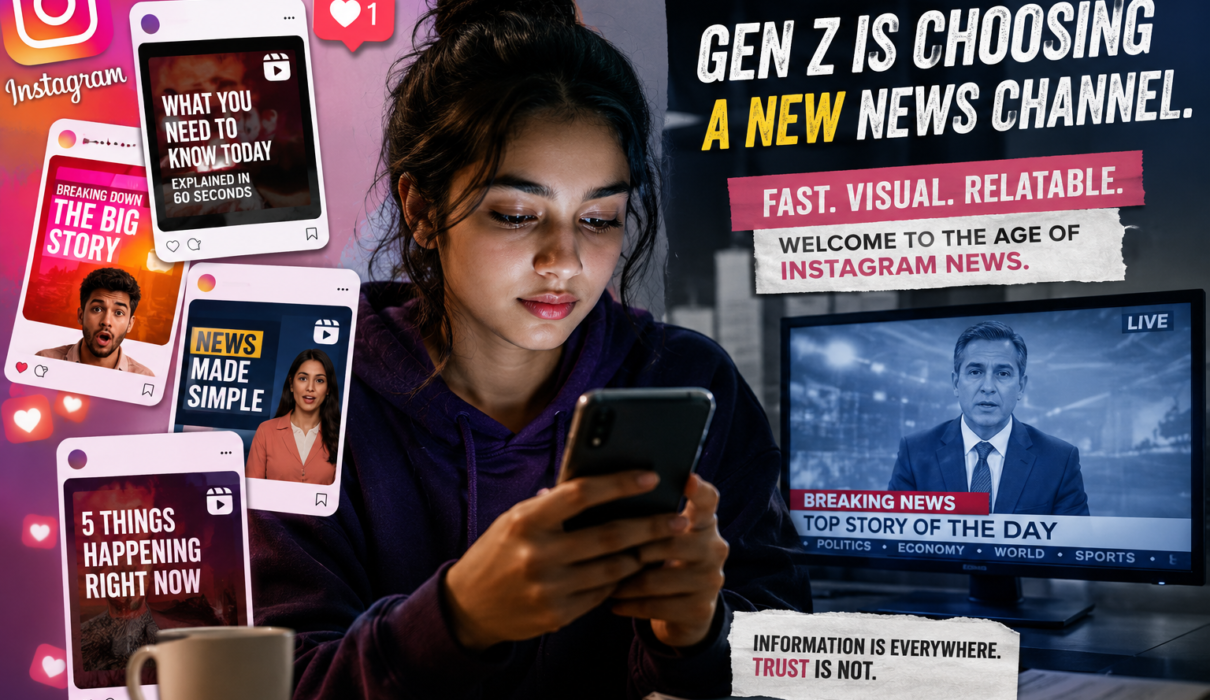
A young person may wake up, open Instagram, scroll through a few Reels and encounter political developments, international conflicts, celebrity controversies, economic news and breaking events all before deliberately visiting a news website or turning on a television.This does not necessarily mean that young people have stopped caring about news.
They have changed where they find it.
And that shift is creating one of the biggest transformations in journalism today.
Instagram Is Becoming the Front Door to News
Social media is no longer merely a place for entertainment. It has increasingly become a gateway to current affairs.
The 2025 Google Kantar research on Indian Gen Z found that 91% of respondents rely on social media platforms to discover news, while 88% use video platforms. The study also found that young audiences prefer news that is visually compelling, emotionally engaging and relevant to their interests.
That helps explain why a 45-second Instagram Reel can sometimes reach a young audience more effectively than a 30-minute television debate.
The Reel is short. It is visual. It appears in a feed the person is already using.
The news simply appears.
The News Is No Longer Something Young People “Go To”
This may be the biggest change. Previous generations often had to actively seek information. You bought a newspaper. You turned on the television. You visited a news website.
Gen Z increasingly receives information passively through recommendation systems.
A student scrolling through Instagram for entertainment might suddenly see a Reel explaining a Supreme Court judgment. Another might encounter a creator discussing unemployment. Someone else might learn about an international conflict through a 60-second explainer.
The boundaries between entertainment, commentary and journalism have therefore become increasingly blurred.
The Reuters Institute’s 2026 India report describes the country’s news environment as increasingly platform-dominated, with social media and video platforms providing an important route to news alongside traditional media.
This is not necessarily the death of journalism.
It is the transformation of how journalism reaches its audience.
Why Does Gen Z Prefer Instagram?
There are several reasons.
1. Speed
Traditional news can feel slow compared with social media. A major event happens, and within minutes, videos, explanations and reactions begin circulating online.
Young audiences have become accustomed to receiving information almost instantly.
2. Simplicity
Complex subjects can be difficult to understand when presented through lengthy articles or television debates.
That simplicity is attractive.
3. Personality
A television news anchor represents an organisation.
An Instagram creator can feel like an individual speaking directly to the viewer.
That creates a different relationship.
A young person may feel: “I understand this person’s way of explaining things.”
The creator becomes familiar, and familiarity can influence perceived credibility.
4. Visual storytelling
Gen Z grew up surrounded by smartphones, short videos, memes, graphics and visual communication.
A headline followed by a photograph may feel less engaging than an animated 30-second explanation.
News organisations are increasingly adapting to this reality themselves.
But Is Gen Z Actually Trusting Instagram More?
This is where the debate becomes more complicated.
Using Instagram for news does not automatically mean trusting everything on Instagram.
In fact, the Google–Kantar study found an important contradiction: Indian Gen Z strongly uses social media to discover news, but established news organisations still enjoy higher trust than individual creators.
This distinction is crucial.
Gen Z may discover a story on Instagram and then search Google, watch a news channel, read a newspaper or consult another source before deciding whether to believe it.
The Algorithm Knows What You Like
There is another problem that deserves much more attention. When people consume news through social media, they do not necessarily receive the same news as everyone else. The algorithm learns what they watch. if someone repeatedly watches political content from one perspective, they may receive more of it. If someone engages with sensational stories, they may receive increasingly sensational material.
Over time, a person can begin to live inside an information environment that constantly confirms what they already believe.
This is the danger of the algorithmic echo chamber.
Traditional News Has a Problem Too
It would be unfair, however, to blame social media for everything.
Traditional media organisations have their own challenges. Young audiences frequently complain that television news is too loud, too repetitive, too partisan or too focused on conflict. Television debates can sometimes appear more interested in winning an argument than explaining an issue. And when audiences repeatedly encounter sensationalism, trust declines.
The Reuters Institute’s 2026 India data shows overall trust in news at 39%, down four percentage points from the previous year.
That decline should concern traditional news organisations.
The Future May Not Be Instagram vs News Channels
Perhaps the wrong question is: “Will Instagram replace television news?”
The more likely future is a combination.
News organisations will continue producing journalism. But their journalism will increasingly be distributed through Instagram, YouTube, WhatsApp and other platforms.
A young person might first see a story through a Reel, watch the full explanation on YouTube, read the original report on a news website and then discuss it with friends on WhatsApp. The platform may change.
The need for trustworthy journalism does not.
Conclusion: The News Channel Is No Longer a Place
For earlier generations, a news channel was a television station.
For Gen Z, a news channel can be a creator, a Reel, a YouTube video, a WhatsApp message or a post appearing between two pieces of entertainment. The newsroom is no longer necessarily a physical place.
It is becoming an ecosystem.
Instagram may not replace journalism but it is changing who delivers it, how quickly it spreads and how young people encounter it. And that creates both an opportunity and a warning. The opportunity is enormous: journalism can become more accessible, visual and engaging. The danger is equally enormous: misinformation can become just as accessible, visual and engaging. The future of news will therefore depend on something more important than whether Gen Z chooses Instagram or television Because in the age of Instagram news, being first may win the view—but being right should still win the trust.